Text it
One tap opens your SMS app with the code filled in, and the gateway replies with what happened. A cell signal is enough; no data needed. The SMS webhook is built and tested; the live gateway number is coming.
 Blackout
A private balance you can spend when the internet goes dark.
Private SOL and USDC on Solana. Your phone signs a payment with no internet and sends it as one SMS, or as a QR code that any phone with a connection can carry.
This phone has no data. Pick a message: it signs a real payment code on the phone and sends it as one text. On the local test chain the reply is the gateway's own.
The world is becoming increasingly vulnerable.
Cyberattacks disrupt critical infrastructure. They ground flights and shut systems down.
They expose how much of life now runs on the internet.
Yet nobody is prepared for the day everything goes dark.

Built for the moment traditional systems fail, BLACKOUT joins a private balance with offline payments, so you can send funds even without internet access.
The future of financial freedom shouldn't depend on a connection.
What "offline" means here: your phone needs a cell signal to send the SMS, or a nearby phone with internet to carry the QR code. A payment settles when its code reaches the gateway.
The private side moves money between accounts without touching the chain. The offline side lets your phone spend it with no internet. Every screen below is the real BLACKOUT app.
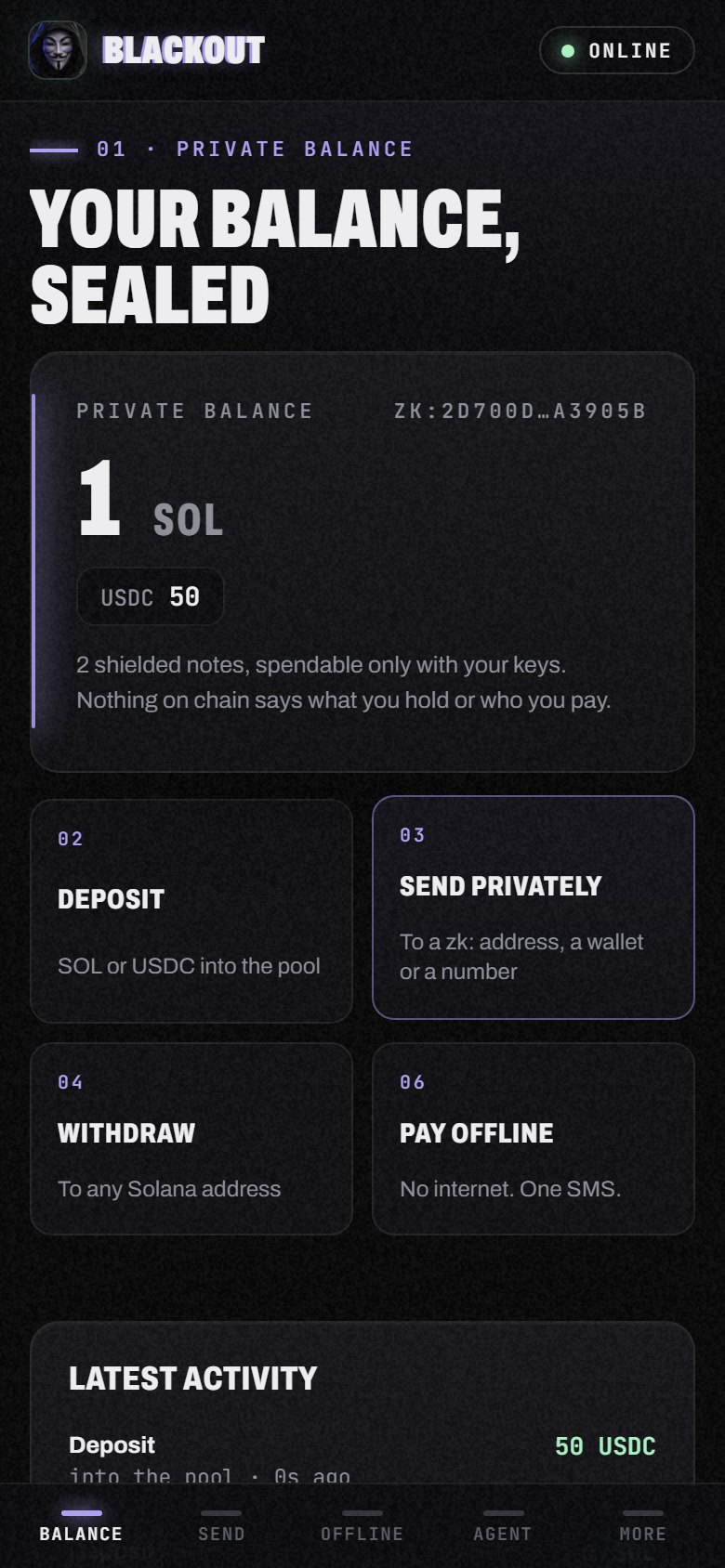
Put SOL or USDC into the pool from your own wallet. From then on you hold a private balance that only your keys can spend. No BLACKOUT fee on deposits.
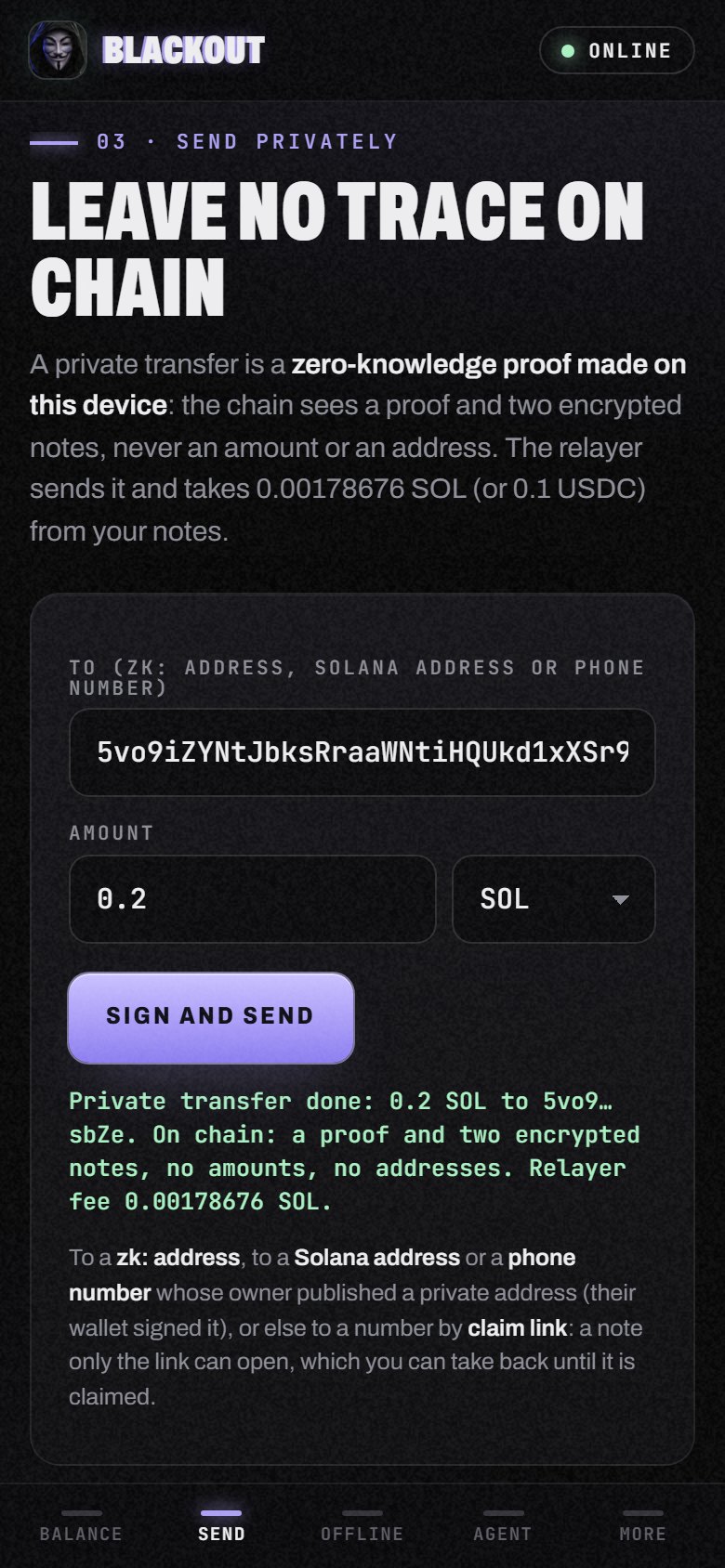
Your phone makes a zero-knowledge proof and a relayer sends it. The chain sees a proof and two sealed notes: no amounts, no addresses, not your wallet. To any other address, the pool pays out on Solana, at once or with the next wave.
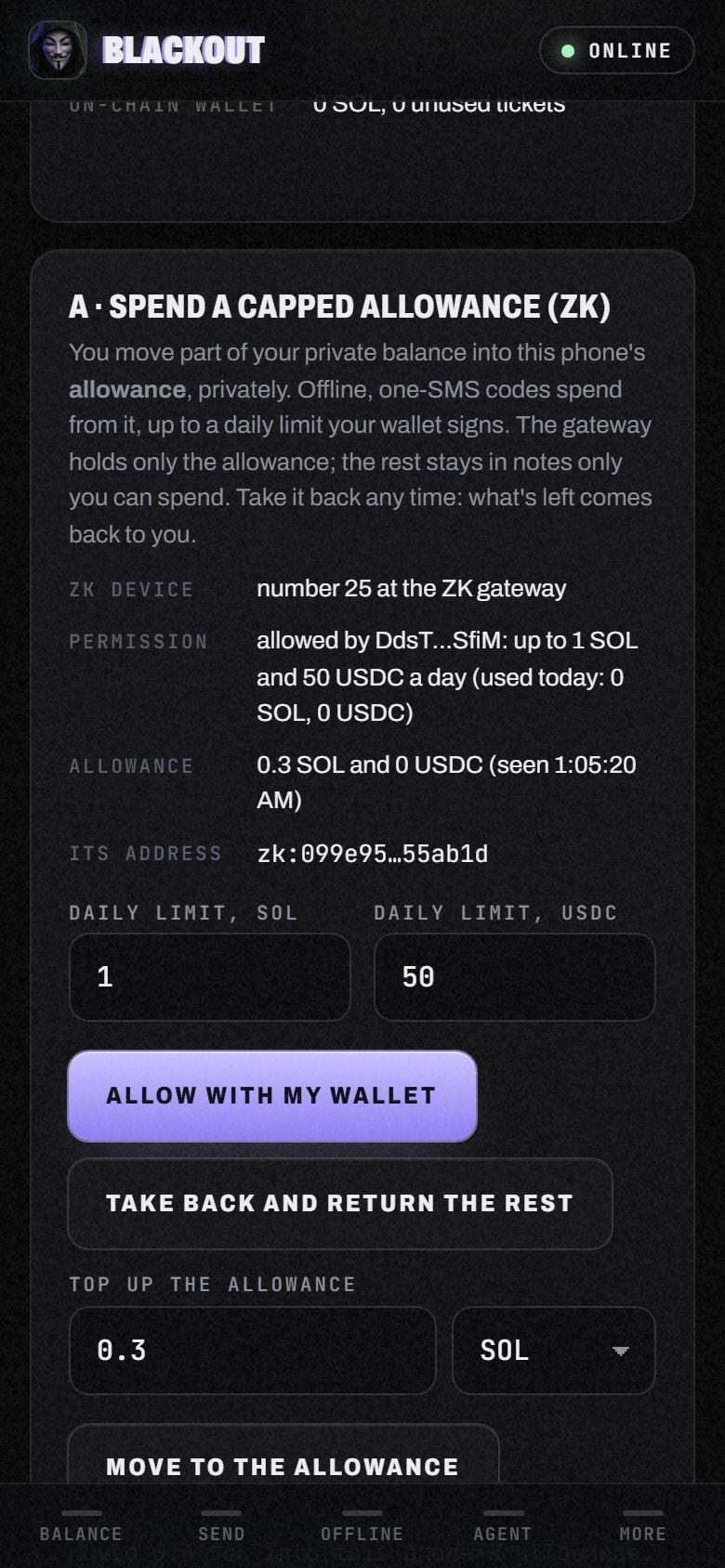
Once, online: you move part of your private balance into this phone's allowance, with a daily limit. Nothing can spend more than the allowance, and you take the rest back any time.
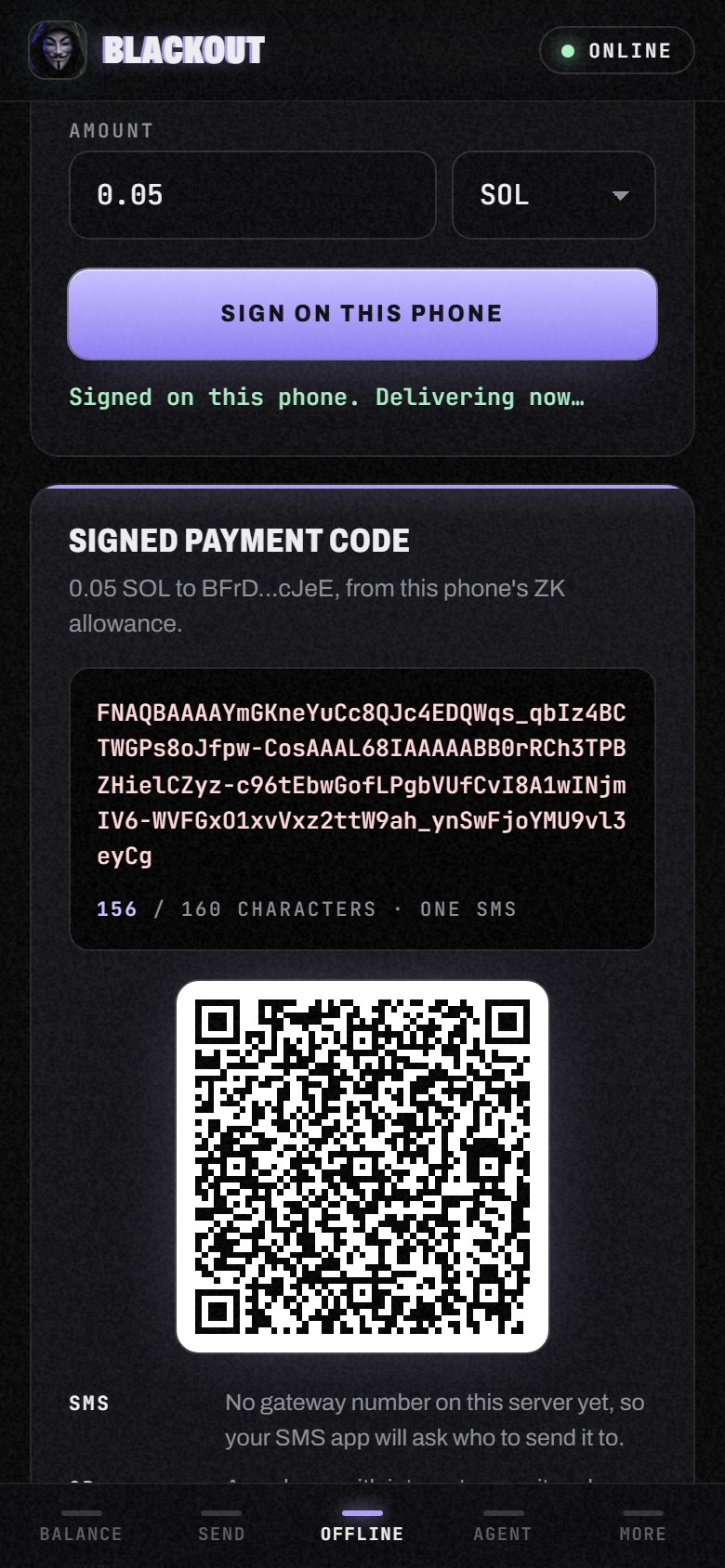
The phone signs the payment with a key that never leaves it, and packs it into one 156-character code.
Text it to the gateway. Show the QR code to any phone with internet. Or do nothing: the queue sends it when you're back online.
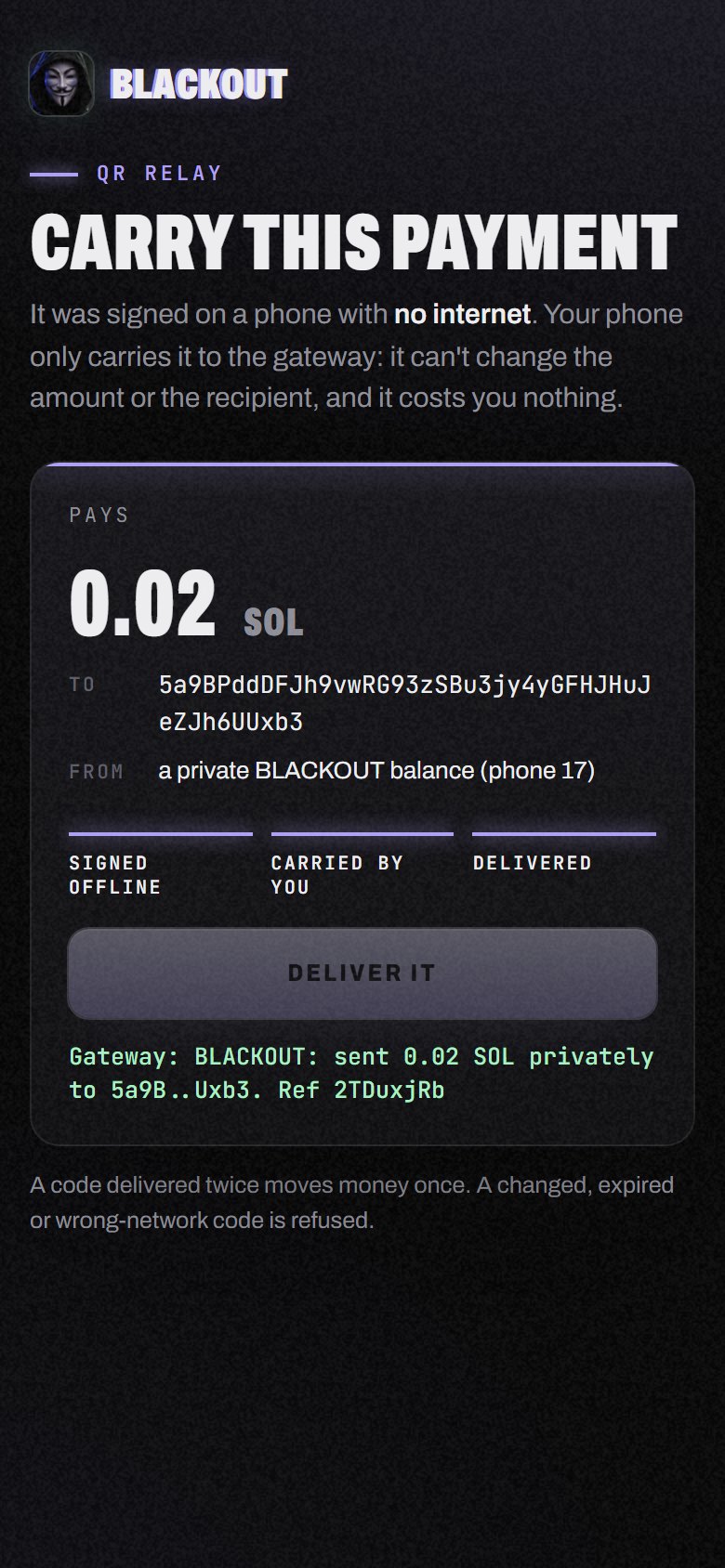
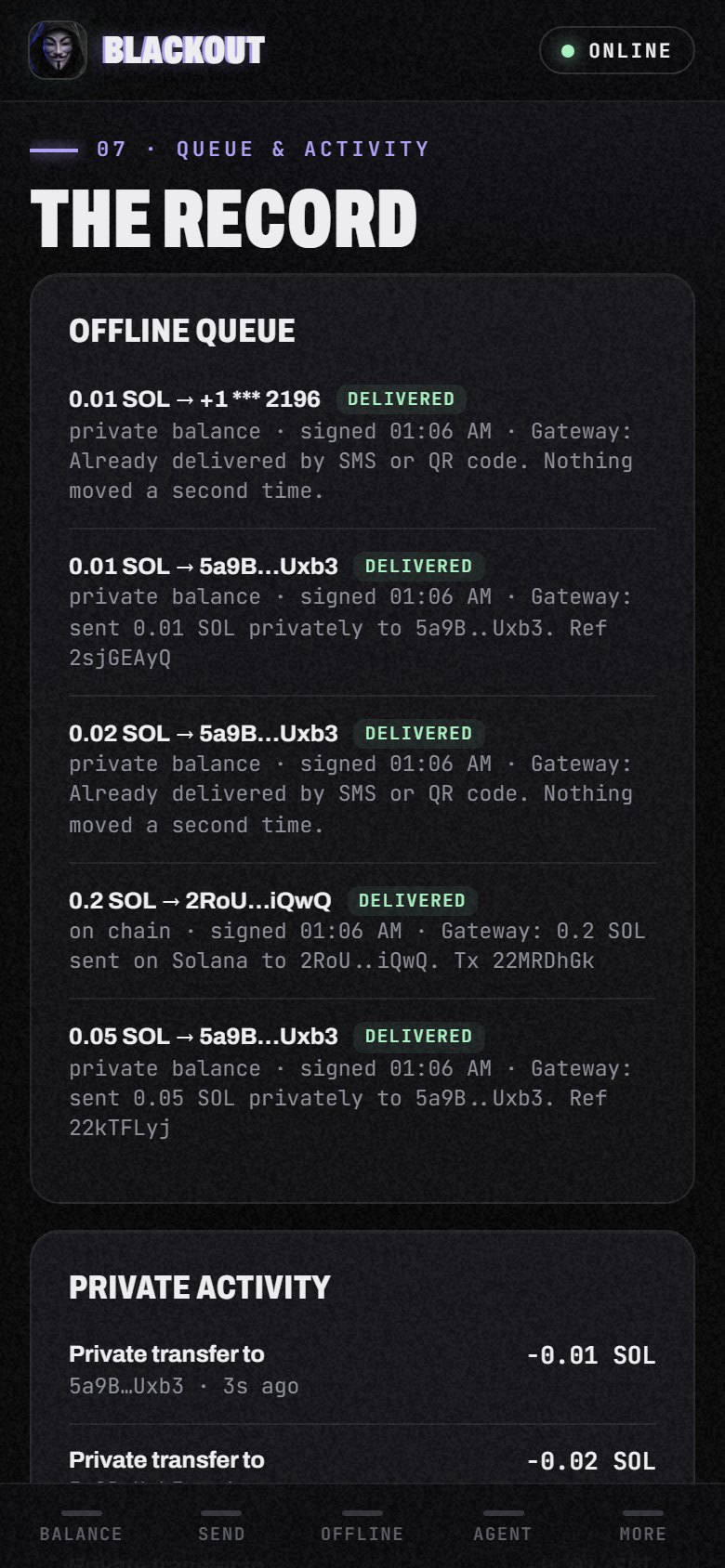
It settles when the first copy reaches the gateway. Every later copy is turned away, so nothing is ever paid twice.
One tap opens your SMS app with the code filled in, and the gateway replies with what happened. A cell signal is enough; no data needed. The SMS webhook is built and tested; the live gateway number is coming.
Any phone with internet scans the QR code and delivers it. It can read the payment but can't change the amount or the recipient.
Every signed code waits in the phone's queue and sends itself the moment you're back online.
A phone number can receive. A phone with no browser can pay, by text, with a card of one-time codes. An agent turns plain words into a payment you confirm. Below is a real exchange, recorded from a run on the local test chain.
Twenty codes. Each works once. The gateway asks for one by its number, so a stolen phone alone can't pay.
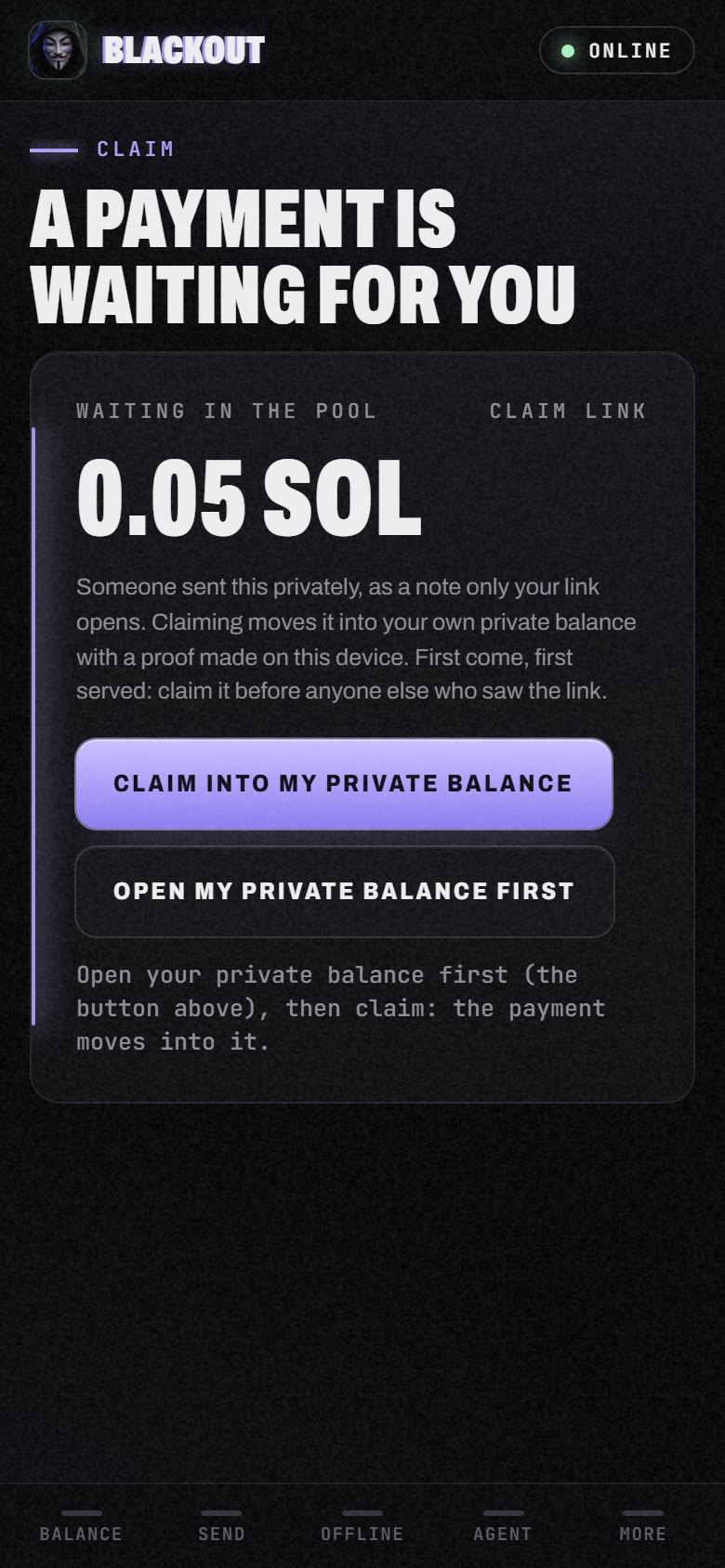
If the number has an account, it lands there privately. If not, the number gets a text with a claim link; whoever claims must prove the number with a texted code, so a forwarded link alone can't take it. Unclaimed after 7 days, it comes back.
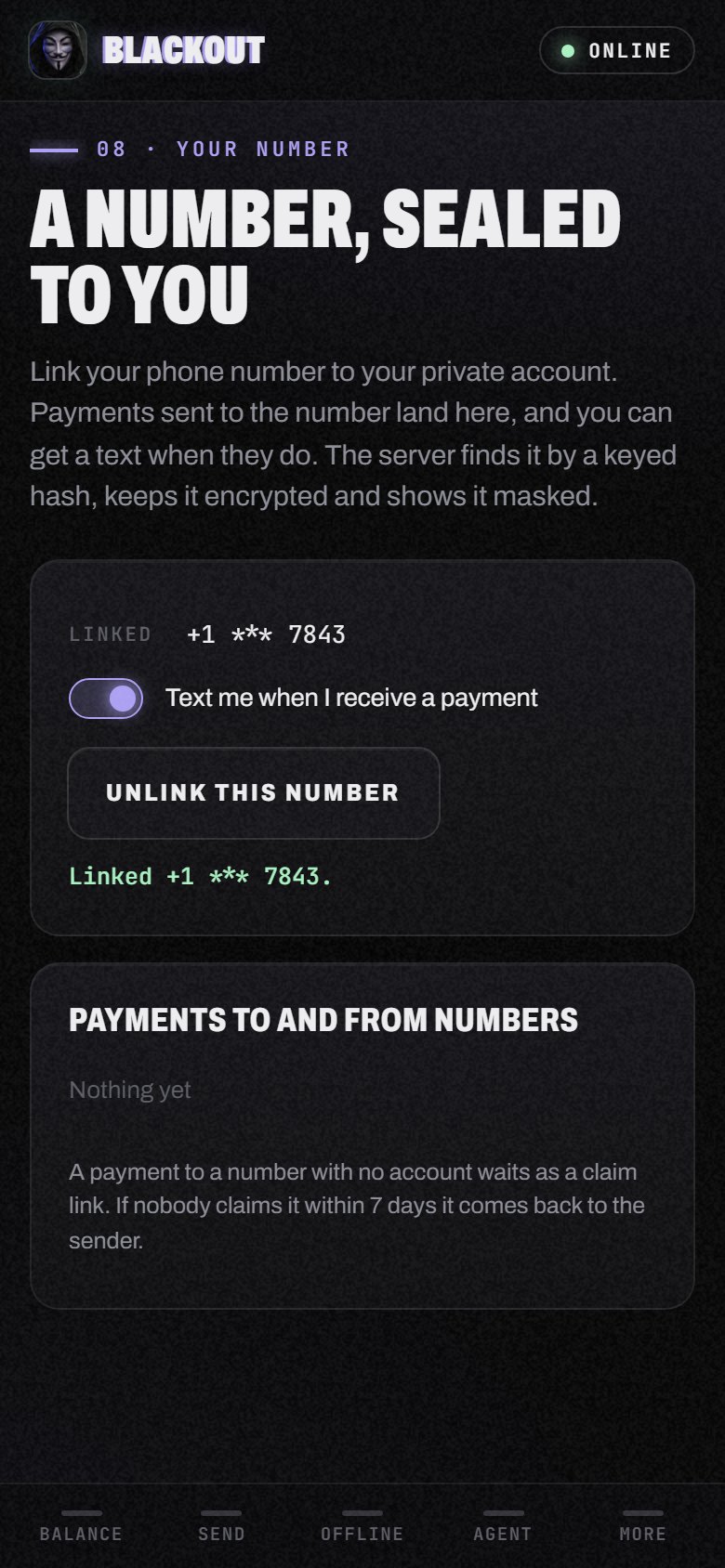
Link your number once with a 6-digit texted code. Turn on texts and a payment that reaches you sends a short notice. The server finds your number by a keyed hash, keeps it encrypted and shows it masked.
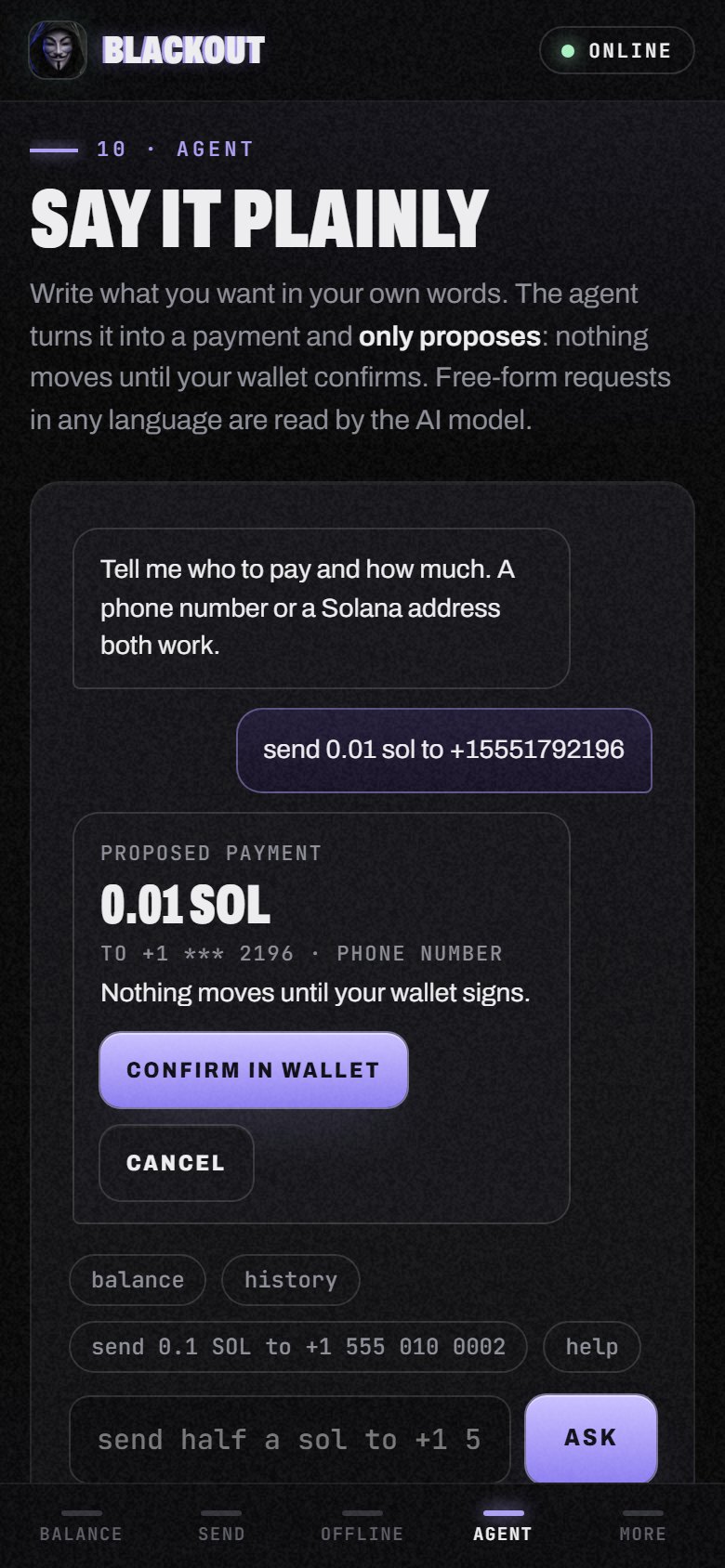
Write "send 0.01 sol to +1 555…" in your own words. The agent turns it into a proposed payment and nothing moves until your wallet signs it.
Free-form reading by the AI model switches on with a live model key; fixed commands work today.
Every BUILT item runs end to end on a local Solana test chain today. Nothing here is on mainnet yet.
SOL and USDC in the pool become sealed notes that only your keys can spend. A private transfer is a zero-knowledge proof, made on your own device in seconds and checked by the pool's Solana program. Payouts to other addresses leave in waves.
Neither our server nor the relayer holds a key that can move your money. Not audited yet, and its trusted setup is a local test one.
Your wallet signs one fixed message, once, and your private keys are made from it on your own device. It is not a transaction, so it can never move anything on any chain, and our server never sees the keys.
A WebCrypto Ed25519 key created non-extractable: the browser signs with it but never hands it out, not even to the BLACKOUT app.
115 bytes, 156 characters. Each carries an expiry and a sequence number and is checked against the phone's daily limit. Two copies of one code move money once.
The phone's own wallet signs a finished Solana transaction on a durable nonce. The gateway only rebuilds and broadcasts it; changing anything breaks the signature.
A number is linked with a 6-digit texted code, looked up by a keyed hash and stored encrypted. Claim links show what waits but can't take it: the claimer proves the number with a fresh code.
Your wallet allows text payments once, with a daily limit. Each payment by text spends one of 20 one-time codes, and too many wrong codes lock the card.
A single backup line restores your whole private balance with no wallet and no server. A viewing key shows everything and spends nothing, for an accountant or an auditor.
A working prototype on a local Solana test chain: a private balance in a zero-knowledge pool, private sends, withdrawals, offline codes by SMS, QR and queue, payments to phone numbers with claim links, a code card for basic phones, and the agent.
An outside audit of the pool, and a trusted-setup ceremony anyone can join.
Real texts. Today they stay in a local outbox.
The whole app on Solana devnet, open to try.
Bluetooth and mesh hand-off.
After the audit and the ceremony.
The future of financial freedom shouldn't depend on a connection.